

You are halfway through a serious meeting, trying to keep your cool while your tongue feels like sandpaper. You are conscious about your breath and your confidence is hanging by a thread. You sip your coffee, but somehow that makes it worse. You worked two nights on that presentation and yet you lack the confidence to deliver it due to various oral hygiene conditions.
In today’s world, we talk endlessly about gut health, skincare routines, haircare tutorials, but when was the last time you thought about your oral well-being? Probably never. While dry mouth may seem like a small inconvenience, trust me, it is not. It broadly refers to the sensation of oral dryness or reduced saliva production.
When saliva slows down, your mouth loses its natural moisture balance and suddenly, your smile, comfort, and confidence start to dry out too.
Saliva is not just “spit,” it is a combination of electrolytes, water and organic micromolecules and macromolecules that plays multiple critical roles: lubrication, buffering acid, antimicrobial action, remineralisation of enamel, facilitating speech and swallowing, and maintaining comfort in the oral cavity. The inadequate flow of saliva may cause various oral complications. (https://www.racgp.org.au/afp/2016/july/dry-mouth-xerostomia-and-salivary-gland-hypofuncti)
Dental caries, gum disease, bad breath, difficulty speaking/swallowing, oral infections, mucosal irritation are some effects of dry mouth. According to a research paper published by the Australian Family Physician, dry mouth is “one of the most underappreciated, under-diagnosed and undermanaged” oral health conditions. Times of India (https://timesofindia.indiatimes.com/life-style/health-fitness/health-news/dentists-warn-about-dry-mouth-know-its-meaning-symptoms-and-treatment/articleshow/125023971.cms) published an article warning us about dry mouth and how dentists are asking us to not mistake it for simple hydration.
Dry mouth sneaks in quietly, and we often dismiss it. But these are the red flags that you must not ignore:
● Lips that stay chapped no matter how much balm you apply.
● A sticky, cottony sensation when you wake up.
● Needing water to swallow food comfortably.
● That faint burn on your tongue after spicy meals.
● A dull taste or loss of flavour.
● Persistent throat irritation or bad breath that mouthwash cannot fix.
Is Dry Mouth a Common Problem in our Country?
Dry mouth is not some rare condition, it affects a major population in India simply due to their lifestyle choices. While global studies suggest that 10–30% of people experience it, let us look at some statistics
● A 2023 study (https://journals.sagepub.com/doi/10.1177/0265539X251363871#:~:text=While%20xerostomia%20is%20commonly%20linked,et%20al.%2C%202023) found that over 55% reported some level of oral dryness.
● Among young adults, stress and poor sleep were major contributors.
● A meta-analysis on diabetes (affecting over 100 million Indians) found that nearly 42% of diabetic individuals experience dry mouth symptoms.
● Tobacco and alcohol users reported dryness rates between 24–33%, significantly higher than the national average.
● About 40% smokers experience dry mouth conditions, according to reports (https://pmc.ncbi.nlm.nih.gov/articles/PMC3429961/)
In short, dry mouth in India is not a niche problem.
The Modern Indian Lifestyle Problem
Scroll through your day: coffee in the morning, long office hours, AC air, skipped meals, alcohol on weekends, four hours of sleep, vaping every 5 minutes and constant screens. Add some stress and you are creating the perfect conditions for dry mouth
Dry mouth slowly deprives you of your oral comfort and confidence, until suddenly, it has taken over your eating habits, talking mannerisms, or smile.
What are the risks of dry mouth?
Dry mouth may have multiple etiologies and is prevalent in about 10-30% of the general population, experiencing oral dryness. Yes, it is that common and we are still not talking enough about it.
While medical conditions may be one of the primary causes of dry mouth, your daily habits, stress levels, and even sleep patterns play a huge role. Modern lifestyle with its caffeineholics, deadlines, air conditioning, and endless screen time is practically designed to make your mouth feel parched.
1. Alcohol and social habits
Alcohol does not just loosen inhibitions, it makes you lose your oral hydration too. That post-party cotton mouth? Yes, your body is trying to alert you about your dehydration. Regular drinking, reduces saliva production and alters its protective composition. Did you just reach out for another glass of water? Well, that will not solve your dry mouth problem because that problem runs deeper than that. The thirst sensation (https://pmc.ncbi.nlm.nih.gov/articles/PMC5501731/) is not asking for water but to re–evaluate your habits and think about your oral hygiene.
2. Smoking and vaping
According to WHO (https://www.who.int/docs/default-source/campaigns-and-initiatives/world-no-tobacco-day-2020/wntd-tobacco-fact-sheet.pdf), tobacco smoking poses a serious threat to your general health and worsens your oral cavity. Whether it is traditional tobacco or an alternative you convinced yourself to buy, both reduce saliva flow and irritate oral tissues. A systematic review (https://pmc.ncbi.nlm.nih.gov/articles/PMC11675017/#B1-dentistry-12-00404) on tobacco users found that nearly 26% experienced persistent oral dryness. In India, where tobacco use remains among the highest globally, the risk multiplies.
3. Dehydration and caffeine overload
Coffee, tea, and energy drinks are hydration thieves, yet most of us proudly announce how we literally survive on them. While they keep you alert, caffeine acts as a mild diuretic, which means that it subtly depletes your body's hydration.
4. Stress and anxiety
Stress not only makes you bite your nails, it literally dries you out. When you are anxious, your body’s sympathetic “fight or flight” system kicks in, diverting energy away from non-essential functions, including saliva production. One Indian study published in the Journal of Interdisciplinary Dentistry (https://journals.lww.com/joid/fulltext/2024/14020/stress_and_its_downside_among_medical_and_dental.2.aspx) found that college students reporting high stress levels were far more likely to experience symptoms of dry mouth.
5. Mouth breathing due to nasal obstruction causes sleep-apnoea
When one breathes predominantly through the mouth, it may be a bigger problem than anticipated. Mouth breathing may cause severe structural and oral issues, the oral mucosa is more exposed and saliva film is stressed/evaporates faster, contributing to dryness. This aligns with your description.
6. Hormonal fluctuations
Menstrual cycles, pregnancy, and menopause can alter hormone levels that influence fluid balance in the body.
7. Reduced salivary gland flow:
As one ages, salivary gland function may decline naturally, reducing baseline flow. Medical conditions (e.g., diabetes, Sjögren’s syndrome, head or neck radiotherapy) can damage glandular tissue or its neural control. According to a study in Sweden, approximately 27.3% women and 21.3% men experience dry mouth. According to another study, out of the 0.9-68% population that experiences dry mouth, 30% are above the age of 50.
The Oral Implications of Dry Mouth:
Let us understand all the oral factors and complications of dry mouth:
Increased dental caries (tooth decay)
Saliva helps clear food debris, neutralises acid, and supports remineralisation of enamel. Without it, acid-producing bacteria attacks with all its might, the enamel demineralises, and caries develop.
Gum disease and mucosal problems
Reduced saliva means less antimicrobial action and less clearance of bacterial biofilms, increasing risk of gingivitis, periodontitis, mucosal infections, candidiasis, and bad breath.
Oral discomfort, burning, dysphagia, taste changes
Individuals often report burning tongue, difficulty swallowing, altered taste, cracked lips, and mucosal soreness due to a prolonged dry mouth condition.
Bad breath
No saliva means no natural cleansing. Odor-causing bacteria multiplies and hence you lose that smile instantly.
Management and Remediation: What can be done?
There are various evidence-based remedies available, ones the primary problem is identified, let us look at a few of them:
Dry mouth is caused due to inadequate production of saliva, therefore, to increase saliva production or find substitute for its function, remains a primary goal. According to a study published by the National Library of Medicine (https://www.ncbi.nlm.nih.gov/books/NBK587342/), dryness is associated with high caries risk, the use of fluoride (topical) remains a cornerstone of prevention. So have we cracked the code?
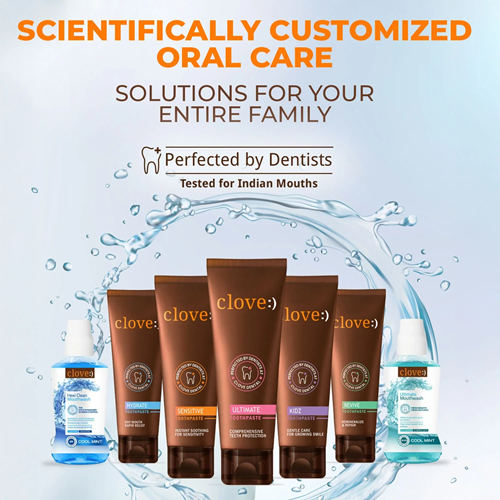
Our Clove Hydrate Toothpaste
This is where smart, science-backed formulations like Clove Hydrate Toothpaste come in. This toothpaste is an oral wellness upgrade.
The toothpaste is designed with our patented Optaflow® technology, clinically shown to increase saliva production by up to 150% versus baseline. It restores the natural moisture your mouth needs without harsh additives.
Key ingredients like sodium fluoride strengthen enamel and help prevent acid attacks, while xylitol supports good bacteria and reduces harmful acids. Together, these ingredients not only keep your mouth hydrated but also protect it from the dryness-related chain reactions such as bad breath, sensitivity, and discomfort.
Brushing twice daily with a fluoride-rich, moisture-locking formula is one of the simplest yet most effective ways to counter daily dryness.
Lifestyle hacks to prevent dry mouth conditions:
● Brush twice a day with our clove hydrate to get that confident smile back.
● Keep adequate fluid intake and minimise mouth-breathing.
● Diet and sugar control, especially for individuals with diabetes (who are at higher risk of dry mouth, cavities and gum disease) maintaining good glycemic control, moderating sugary/acidic foods, and avoiding frequent snacking will reduce acid formation.
● Reduce caffeine, alcohol, and energy drinks gradually.
● Yoga, journaling, or even a walk outdoors can lower cortisol and improve saliva flow.
● Saliva production slows naturally during sleep, so the better your sleep quality, the quicker your mouth recovers.
Dry mouth is a common condition that puts you at higher risk of cavities, gum disease, oral discomfort and reduced quality of life. At Clove Oral Care, we strongly believe that dental and oral hygiene is imperative to each one of you. Every oral problem requires a personalised remedy and we carefully consider oral biology before curating our products. Our Clove Hydrate gives you 24-hours of moisturization and oral protection. The bioactive formula proactively fights germs and inflammation causing bacteria while simultaneously protecting the good bacteria that is important to maintain oral hygiene.